Featured

Will Gun Bans Truly Make Us Safer?

In the world of current events, arguments and debate about gun control find themselves at the forefront of much discussion. When looking at the core argument, you find the issue is freedom versus safety. But what exactly are the specific arguments? What should the goal of discussion be? While it may be easy to pick a side and believe that you are right, it is important to try and understand the multiple perspectives of this argument and rationalize their respective point of views. Like many topics in politics, there are rarely absolutes, and I implore you as the reader to take that into consideration. Before diving into the specific arguments, it is imperative that I mention that both sides of this argument wish for the best possible outcome. This is not simply a debate of evil vs non-evil. 

In a blog written by Tom Stevenson, the English native explains his take on America’s situation. As an “outsider” he simply does not understand why Americans continue to disregard stricter gun control. He states that America’s obsession with guns creates more opportunity for “bad actors and the mentally ill” to gain access and commit atrocious crimes of mass murder and ultimately leading to the death of thousands of innocent lives. While this may be true, I believe that this level of analysis is misleading and incomplete. I believe that an individual’s right to protect themself is a fundamental right of the United States and the prevalence of guns that currently are being used by bad actors make their legality more legitimate than ever before.

In the United States, guns are equipped to police officers to protect citizens, by citizens who wish to provide protection for themselves, citizens who wish to use them for sport, and by criminals. In order to get a gun in today’s society, US residents must be over the age of 18 (21 for handguns), have not been suspected of a criminal charge that may result in a one year sentence, have not been convicted of domestic violence, and in some states have various licenses. On top of these restrictions, background checks are also given to prevent those who are mentally ill from obtaining a firearm. According to business.time.com, “899,099 firearm purchases have been denied by the FBI between November 30, 1998 (when the FBI began processing background checks) and December 31, 2011. Of those, 7,879 were denied because of issues relating to the would-be purchaser’s mental health” The FBI and other American agencies have since increased their efforts. All of this information shows that guns are not as easy to obtain as most people think. There is a process to obtaining a gun that requires extensive checks on one’s record and mental health. 

However Stevenson’s argument still stands. Wouldn’t the United States as a whole avoid this situation with an all-out ban? The truth is not necessarily. Terrorism and crime is non-unique. People will still end up exchanging weapons with those that would harm the United States. In fact, a large amount of weapons are imported from countries like Brazil and Colombia. If the government truly wanted to prevent weapons from falling into the wrong hands, then they should tighten on regulations. The U.S. government should alter trade laws and enforce stricter importation enforcement and not the rights of the American people. At the end of the day, personal autonomy is a fundamental right of America, and the freedom to protect oneself is a derivation of that right. 
Only by Understanding Can We Reach a Solution

Gun debates are at the forefront of political issues. Many liberals believe that the debate is about the “good against the evil.” I believe that this antagonizing rhetoric is one of the reasons that this debate reaches no conclusion. 

There is a popular saying in the world of politics. “If you want to have an endless argument, talk about the problem. If you want to have a pleasant discussion, begin by discussing solutions.” The fact of the matter is that the gun debate is a battle against a culture which has bread throughout America for over 200 years. When some liberals label those who disagree with their viewpoint as “evil” – all hope for any sort of cordial discussion is lost. In an article on the New Republic, the author Phoebe Maltz Bovy claims the gun debate is not about a discussion of good or bad gun owners but rather “It’s about placing gun ownership itself in the “bad” category. To simply label gun ownership as a “bad” is a flagrant use of group identity and group guilt. When a mass murderer commits a crime with a gun, this does not mean that all gun owners are responsible for the crime. The logic is more clear when talking about a situation which most people can identify with. A person driving has a lapse of judgement and causes a crash killing another person. While this hypothetical is tragic, it would be ridiculous for anyone to then state that all individuals who drive cars are responsible for that death and therefore we should ban cars. 

I understand the argument though. A common representation of the counter is that “guns don’t kill people, people kill people.” I also believe that this is a ridiculous claim made by gun owners. Of course no one actually believes that guns magically kill people with no human intention behind it, but the issue is that the gun, as a tool, is capable of killing many people at one time. When gun advocates use this logic to defend their viewpoint, it again strangles any sort of true scrutiny on the topic as a whole. I believe that every rational human in America cares about the safety of the country, therefore as a country we must do our best to avoid straw man arguments to support our viewpoints. This discussion is not about winning the argument, it is about finding common ground to fix a problem that has plagued our country and taken innocent lives. 

 The Washington Post took this approach back in 2015 in their article “America has to do more to prevent gun violence” where they write “No one piece of legislation or policy will solve the problem of gun violence. Many actions are needed.” Believe that an all out ban of guns is the “only way” is disingenuous. Officials and policymakers must look at the situation of gun violence coupled with American culture as a whole to reach a good outcome. I believe that it is rhetoric like this which will solve what feels like a never ending debate and hopefully lead a more safer America. 

Issue: How Should the Government Respond to Increase in Gun Sales due to the Coronavirus

With the prevalence of media attention on the novel coronavirus also known as COVID-19, one may wonder the impact of a pandemic on modern society. Fear is one of mankind’s strongest emotions. It creates panic and wires the brain into a fight or flight response. One of the most prevalent ideas of panic lies in the fear of martial law and/or the possibility of anarchy should the pandemic grow out of control. While this concept alone seems far-fetched, individual actions prove otherwise. As panic over the coronavirus increases, gun sales in Southern California have sky-rocketed.  Dennis Lin, owner of Gun Effects and Cloud Nine Fishing in Industry states that gun sales have nearly doubled due to the fear of coronavirus. This surge in gun sales is due to the idea that a lack of services and possible resources may cause civil unrest amongst populations. It is already apparent that many individuals are flocking to stores and buying all the home supplies and non-perishable food they can. This logic behind panic-buying is also being applied to guns and ammunition. The fact that fear is driving individuals to prepare to defend themselves with guns begs the question of how should the government intervene? And would any intervention cause even more panic?

According to the Sacramento Bee, coronavirus fears have caused many individuals to buy guns for the first time. People who tell me that they don’t like guns, but they’re here to begrudgingly buy one,” Gabriel Vaughn, owner of Sportsman’s Arms In Petaluma, told the TV station. “And if it makes somebody feel safe and they’re legal to own one, then sure Sales on Ammo.com, an online ammunition store, were 68 percent greater from Feb. 23 to March 4 than they were the preceding 11 days. In order to address panic-buying of arms, many states and individual cities are looking to legislative loopholes to potentially stop these sales. The mayor of Champaign, Illinois has included potential ordinances that would ban the sale of alcohol and guns under the Coronavirus Emergency Act. While no direct action has been taken thus far, the potential implications of a part-time ban are beginning to sprout in all parts of the United States. 

Legally government officials would have the right under certain legislative acts to enact part-time bans of weapons. However, I believe that this would cause immense panic amongst the public. The current state of affairs within the United States is one that requires government officials to be wary of creating more fear. If the government were to ban gun sales, even for a short period of time, the public would see the act as “controlling.” People have already begun to panic and human nature teaches us that panic and fear breads more panic and fear. If the government responds to the increase in gun and ammunition sales with panic, the people shall panic respond and an endless cycle ensues. Nevertheless, the issue of people buying guns and ammunition at exponentially large levels is still a cause for concern. What should officials do to combat this? 

I believe that the issue of panic buying guns is a symptom of a much more prevalent issue which has engulfed the United States. The symptoms of mass-purchasing any item is due to panic as a whole. Mass-media attention as well as fear mongering by misinformed public figures such as celebrities and social media influencers have created an unjustified heightened sense of fear throughout the public. When the NBA commissioner announced the suspension of the season, people submitted to their own conclusions. They identify danger in the unordinary. In order to address the issue of panic and in turn the panic-purchasing of firearms, officials should actively try to reassure the people that while we are in a pandemic the danger to most individual lives in America is small. The actions taken by officials and other large companies and corporations is a response to lessen the spread of the disease to sensitive groups who are truly at risk. The government should reassure the people that the momentary change in daily lifestyles is a precaution and not a last resort measure. If officials can succeed in spreading this narrative, then the issue of panic as well as panic purchasing will both become solved. 

References

Knighton, Tom. “Coronavirus-Based Fears Sparks Gun Sales In Southern CA.” Bearing Arms, Bearing Arms, 12 Mar. 2020, bearingarms.com/tom-k/2020/03/12/coronavirus-gun-sales-southern-ca/.

Stunson, Mike. “Gun and Ammo Sales Surge in US with Coronavirus Fears. ‘Better Safe than Sorry’.” Sacbee, The Sacramento Bee, 13 Mar. 2020, http://www.sacbee.com/news/nation-world/national/article241164136.html.

Issue: Freedom or Safety?

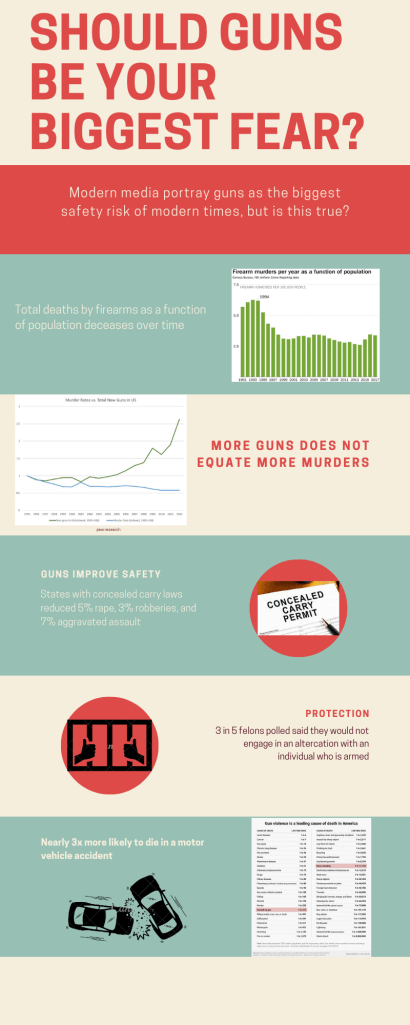
In the world of current events, arguments and debate about gun control find themselves at the forefront of much discussion. When looking at the core argument, the issue is freedom versus safety. Are the freedoms given through the right to bear arms more important than the potential dangers relating to the existence of firearms in modern society Like many topics in politics, there are rarely absolutes. While guns do provide a certain level of freedom, they are not without the potential to cause harm. However, it is imperative to try to quantify and empirically define how much harm guns truly cause. Is the amount of scrutiny and media coverage of guns proportional to the actual dangers of guns? And in terms of freedom, what freedoms do guns truly give individuals that they do not already have?

In the United States, guns are equipped by police officers to protect citizens, by citizens who wish to provide protection for themselves, citizens who wish to use them for sport, and by criminals. In order to get a gun in today’s society, US residents must be over the age of 18 (21 for handguns), have not been suspected of a criminal charge that may result in a one year sentence, have not been convicted of domestic violence, and in some states have various licenses. On top of these restrictions, background checks are also given to prevent those who are mentally ill from obtaining a firearm. According to business.time.com, “899,099 firearm purchases have been denied by the FBI between November 30, 1998 (when the FBI began processing background checks) and December 31, 2011. Of those, 7,879 were denied because of issues relating to the would-be purchaser’s mental health” The FBI and other American agencies have since increased their efforts. All of this information shows that guns are not as easy to obtain as most people think. There is a process to obtaining a gun that requires extensive checks on one’s record and mental health. Therefore the common misconception that guns are always at the hands of those who can cause harm is an overstatement of some sorts. It is reasonable to assume that there are those who wish to cause harm. It is also reasonable to assume that if these individuals wanted to obtain a firearm, they likely could find some way to do so. However at the same time it is reasonable to assume that someone who wishes to cause harm will find a way to cause harm, whether incorporating a firearm or not. 

Many believe that an overall ban would lead to a decrease in homicide rates. In Australia, the government implemented a firearm ban which led to many studies on the effects of the ban. Researchers who have surveyed all of the studies (meta-analysis) on the topic have concluded that Australia’s firearm program “did not have any large effects on reducing firearm homicide or suicide rates.”

Yet another study found “Homicide patterns (firearm and non-firearm) were not influenced by the NFA [gun ban/buy back program], the conclusion being that the gun buy-back and restrictive legislative changes had no influence on firearm homicide in Australia.” Overall, using evidence from a country that implemented a firearm ban, there exists no empirical evidence that supports increased safety for citizens. 

The question of whether the government has a stake in protecting its citizens is obvious, but at what cost. Both sides are arguing for personal autonomy. People have a right to live and also the right to protect themselves. The Second Amendment, whether one agrees with it or not, gives the people the right to bear arms as a means to protect themselves. In D.C. v Heller (2008) the Court decided that citizens possess the right to own a gun for self-defense. However in the majority opinion, the Court did not make clear as to what degree the Second Amendment can be regulated. Delivering the majority opinion, Justice Scalia wrote that “the right secured by the Second Amendment is not unlimited.” Terrorism and crime is non-unique. Many crimes that are committed in the United States happen with illegal guns, that is guns that do not originate within the United States. If the government truly wanted to prevent weapons from falling into the wrong hands, then they should tighten on regulations. While the idea of the Supreme Court’s opinion on the Second Amendment may not seem important to the debate of safety within the issue of gun control, the actions taken by the United States as a whole must adhere to the boundaries of the law. And the Supreme Court has a duty to protect the most fundamental rights of Americans, the Bill of Rights.

References

 District of Columbia v Heller (2008) Scalia, Majority Opinion

Jeanine Baker, Samara McPhedran, Gun Laws and Sudden Death: Did the Australian Firearms Legislation of 1996 Make a Difference?, The British Journal of Criminology, Volume 47, Issue 3, May 2007, Pages 455–469, https://doi.org/10.1093/bjc/azl084

Popken, Ben. “America’s Gun Business, By the Numbers.” CNBC, CNBC, 2 Oct. 2015, www.cnbc.com/2015/10/02/americas-gun-business-by-the-numbers.html.

Suardi, Sandy. “THE AUSTRALIAN FIREARMS BUYBACK AND ITS EFFECT ON GUN DEATHS.” Wiley Online Library, John Wiley & Sons, Ltd, 3 June 2009, onlinelibrary.wiley.com/doi/full/10.1111/j.1465-7287.2009.00165.x.

“2016 NICS Operations Report.” FBI, FBI, 22 May 2017, www.fbi.gov/file-repository/2016-nics-operations-report-final-5-3-2017.pdf/view.

Whats Happening to Guns in New York and Why You Should Care

Currently in New York, gun laws are facing the biggest challenge they have ever faced in the history of our country. With gun laws being a prime issue for many people including myself, it is important that as a country we understand why this is a pivotal moment in our lives. This situation pertains to gun rights in New York City regarding transportation and usage. There is a regulation which permits residents with specific premises licenses to take their guns to a shooting club/range within the city (of which there are seven). However, this regulation prohibits individuals from bringing their guns elsewhere, such as second homes and shooting ranges beyond the city limits. This regulation applies even if the guns are securely locked in containers, unloaded, and separated from ammunition. It should be noted that a premise license grants one to “have and possess in his dwelling” a handgun. Specifically, the license is designated to restrict the handgun to a single permanent address which may only change under certain circumstances such as transporting them to a shooting club/ range in New York City. First it is important to discuss the technicalities of the situation.

Three people with premise licenses wanted to attend shooting ranges and competitions outside of New York City. The individuals wished to transport their handguns, which the New York regulation prohibits. Therefore, the individuals as well as the New York State Rifle and Pistol Association filed a lawsuit in federal district Court, declaring the regulations from New York City to be unconstitutional. In particular, the Second Amendment is being restricted which petitioners argue require the highest level of scrutiny when discussed. These individuals believe their rights are being overly restricted and the government is going beyond their powers. The competing claim of New York City is that this regulation “Promotes public safety by limiting the presence of firearms on city streets”. However, the city did not present any empirical evidence supporting this claim when transporting an unloaded firearm, locked in a container, separated from ammunition. 

Understanding these technicalities are imperative as the result of this case could potentially change the way the United States views gun laws for generations to come. If New York city manages to justify their regulations under the Second Amendment, then states will have the justification to effectively, in lack of better terms, ban guns in their states.

The question at hand is if  “A New York City rule banning the transportation of a licensed, locked, and unloaded handgun to a home or shooting range outside city limits violate the Second Amendment, the Commerce Clause, or the constitutional right to travel”. The first constitutional problem involves the Second Amendment. This case is extremely important for proponents from both sides of “gun debate”. Vox’s political contributor Ian Millhiser believes it will dictate future gun control laws as a precedent for upcoming regulations or changes. When this case is decided by the Court, it will inevitably dictate the freedom of firearm rights and the regulations associated with them for years to come. 

In terms of societal issues, this case will limit or grant the rights of both the city’s powers and the citizens’s rights in terms of gun control. If the Rifle Association wins, then gun restrictions all around the U.S. will become null. However, if New York wins, the country may see numerous states placing gun bans for its residents. It’s also important to note that even if New York City could justify its policy under the Second Amendment, the city fails the Commerce Clause. The Commerce Clause gives Congress the power to “Regulate commerce with foreign nations, and among the several states, and with the Indian”.  With this clause, the New York City law fails, as its attempts to make residents use shooting ranges within the city; therefore slowing down economic activity beyond city limits. While New York City most definitely will lose in court, their argument under the Second Amendment may make this case may be a golden opportunity for gun reform activists all around the country.

How is the US Justice System Tackling the Issue of Gun Control?

The topic of the Second Amendment and gun control is arguably the single most important safety issue discussed among Americans today. But what does the justice system think? How will their opinions guide the debate? Currently there is pending supreme court case New York State Rifle and Pistol Association v. City of New York which has the potential to guide legislation on the gun laws for years to come. In order to predict how this court case will be decided it is important to look at historical context. In D.C. v Heller (2008) the Court decided that citizens possess the right to own a gun for self-defense. However in the majority opinion, the Court did not make clear as to what degree the Second Amendment can be regulated. Delivering the majority opinion, Justice Scalia wrote that “the right secured by the Second Amendment is not unlimited.”

For the pending court case, it is important to note the argument of mootness, where the state of New York has since removed the law in question, which would remove the need for the court to review the case. Ignoring the idea of mootness for the purposes of this discussion and with the new addition of Justice Brett Kavanaugh, I believe that when this case is addressed by the Supreme Court, they will rule 5-4 in favor of New York State Rifle & Pistol Association (NYSRPA). The majority opinion will likely argue that laws regulating the Second Amendment require similar adaptations of scrutiny that exist regarding the First Amendment. 

While the Court will most likely rule in favor of the NYSRPA, there are conflicting views as to how strict regulations must be in order to remain constitutional. In the denial of certiorari for Friedman v Highland Park (2015), Justice Thomas wrote, “If a broad ban on firearms can be upheld based on conjecture that the public might feel safer (while being no safer at all), then the Second Amendment guarantees nothing […] relegating the Second Amendment to a second-class right.” With the influence of Second Amendment defendants such as Justices Thomas and Scalia, I believe that the Court will claim that statutes involving the Second Amendment must adhere to a test of intermediate scrutiny with framework similar to the O’Brien test. The test will dictate if: 

  1. The regulation is within the constitutional power of the government
  2. The regulation furthers an important or substantial government interest
  3. Is the regulation as least restrictive on Second Amendment freedoms as possible?

Under this level of scrutiny, the New York law will be deemed unconstitutional. New York has so far been unable to provide substantial evidence other than conjecture that their regulation furthers government interest of safety. Additionally the law would be declared not narrow-tailored to be as least restrictive as possible as individuals would be unable to transport their weapon anywhere outside the city. This ruling could create a ripple effect which would remove gun regulations from every standing state legislature. At the end of the day, the Court has a duty to uphold precedents (however vague they may be) and if the public would like to see stricter gun control, they must first change the most fundamental laws the country has, the Bill of Rights.

Design a site like this with WordPress.com
Get started